How Do I Find My Origin Point in Art Cam Express
The tutorial shows how to identify, highlight and label a specific data point in a scatter chart as well as how to define its position on the x and y axes.
Final calendar week we looked at how to make a besprinkle plot in Excel. Today, we will exist working with individual data points. In situations when there are many points in a scatter graph, it could exist a real challenge to spot a particular i. Professional data analysts oft use third-party add together-ins for this, but there is a quick and easy technique to identify the position of any data bespeak by ways of Excel. In that location are a few parts to it:
The source data
Supposing, you accept two columns of related numeric data, say monthly ad costs and sales, and you lot have already created a scatter plot that shows the correlation betwixt these data:
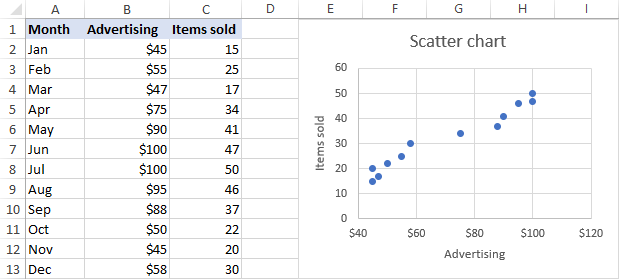
Now, you want to be able to apace discover the data point for a particular month. If we had fewer points, nosotros could simply label each point by name. But our scatter graph has quite a lot of points and the labels would merely clutter it. And then, we need to figure out a way to find, highlight and, optionally, characterization only a specific data point.
Extract x and y values for the data point
As y'all know, in a scatter plot, the correlated variables are combined into a single data point. That means nosotros need to go the x (Advertizement) and y (Items sold) values for the data point of involvement. And here's how you can extract them:
- Enter the indicate's text label in a dissever jail cell. In our case, allow information technology be the month of May in prison cell E2. Information technology is important that yous enter the characterization exactly every bit it appears in your source tabular array.
- In F2, insert the following VLOOKUP formula to excerpt the number of the sold items for the target month:
=VLOOKUP($East$two,$A$2:$C$13,two,FALSE) - In G2, pull the advertising toll for the target calendar month past using this formula:
=VLOOKUP($Eastward$2,$A$two:$C$13,three,Imitation)At this point, your data should wait similar to this:

Add a new data series for the data point
With the source data set up, permit's create a data signal spotter. For this, we volition have to add a new data serial to our Excel scatter chart:
- Right-click any axis in your chart and click Select Data….
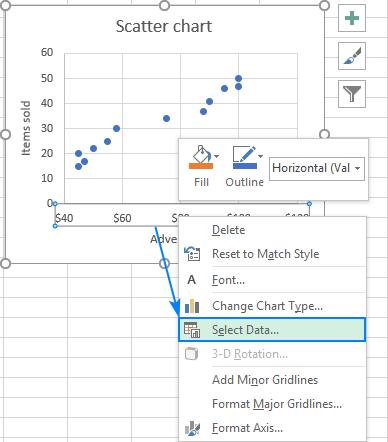
- In the Select Data Source dialogue box, click the Add together button.

- In the Edit Series window, exercise the post-obit:
- Enter a meaningful name in the Series name box, e.k. Target Month.
- Equally the Series X value, select the independent variable for your data point. In this example, it'due south F2 (Advertizing).
- As the Series Y value, select the dependent In our case, it's G2 (Items Sold).
- When finished, click OK.

As the result, a data point in a dissimilar color (orangish in our example) will appear amongst the existing data points, and that is the point you are looking for:
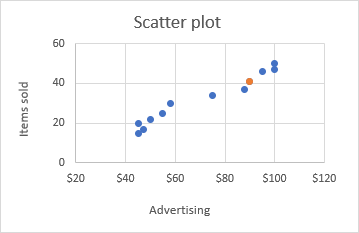
Of grade, since the chart series update automatically, the highlighted point will alter once yous type a dissimilar name in the Target Month cell (E2).
Customize the target data point
There are a whole lot of customizations that you can make to the highlighted information point. I volition share just a couple of my favorite tips and permit you play with other formatting options on your own.
Change the appearance of the data indicate
For starters, let's experiment with colors. Select that highlighted data point, correct click it and select Format Information Serial… in the context menu. When doing so, delight make certain that just a unmarried data point is selected:
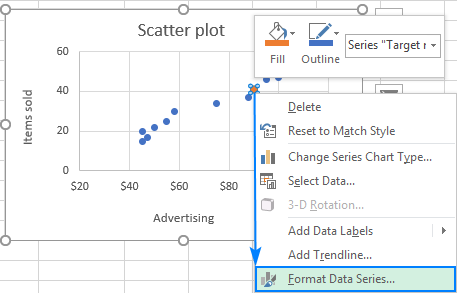
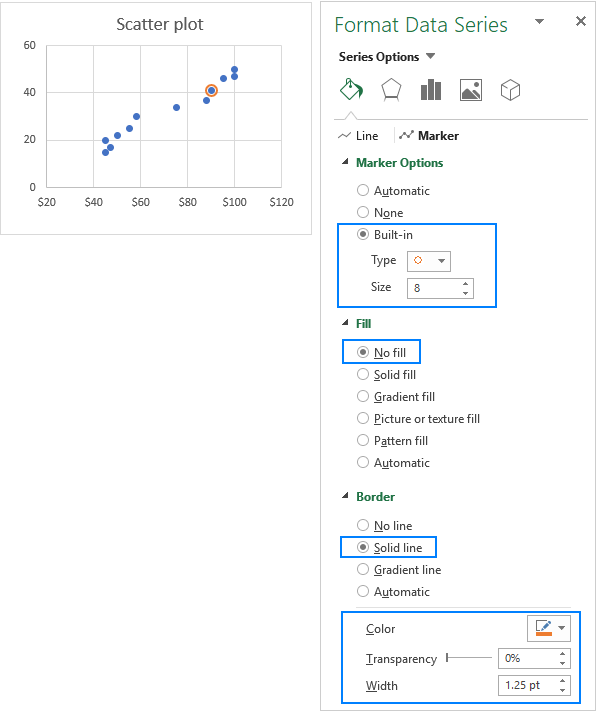
On the Format Data Serial pane, go to Fill & Line > Mark and choose whatever colour you want for the marking Fill and Border. For example:

In some situations, using a different color for the target information bespeak may non be advisable, so y'all can shade it with the same color as the rest of the points, and so brand it stand out by applying another maker options. For example, these ones:
Add the information indicate label
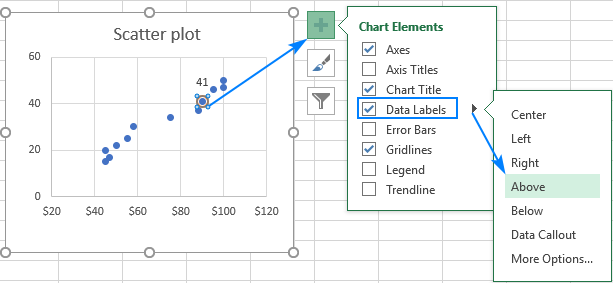
To let your users know which exactly data betoken is highlighted in your scatter chart, you can add together a label to it. Here's how:
- Click on the highlighted information bespeak to select it.
- Click the Chart Elements button.
- Select the Information Labels box and choose where to position the label.
- Past default, Excel shows 1 numeric value for the label, y value in our case. To display both x and y values, right-click the label, click Format Data Labels…, select the X Value and Y value boxes, and set the Separator of your choosing:

Label the data point by name
In addition to or instead of the x and y values, you tin show the month name on the characterization. To exercise this, select the Value From Cell cheque box on the Format Data Labels pane, click the Select Range… button, and choose the appropriate cell in your worksheet, E2 in our case:
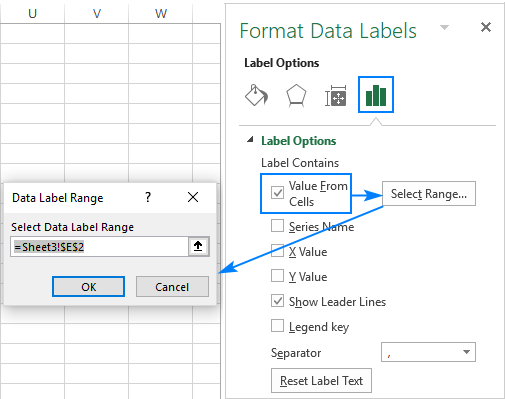
If you desire to show but the name of the month on the characterization, clear the X Value and Y Value boxes.
Equally the result, you will get the post-obit scatter plot with the data betoken highlighted and labeled by proper name:

Define the position of the data signal on x and y axes
For better readability, y'all can mark the position of the data betoken of import to you on the x and y axes. This is what y'all need to do:
- Select the target data point in a chart.
- Click the Chart Elements push > Error Bars > Pct.

- Right-click on the horizontal fault bar and choose Format Error Bars… from the popular-up menu.

- On the Format Error Confined pane, become to the Error Bar Options tab, and modify Direction to Minus and Percentage to 100:

- Click the vertical mistake bar and do the same customization.
Equally the consequence, the horizontal and vertical lines will extend from the highlighted bespeak to the y and x axes, respectively:

- Finally, you tin can alter the color and style of the error bars so that they better fit the colors of your nautical chart. For this, switch to the Fill up & Line tab of the Format Error Bars pane and choose the desired Colour and Dash type for the currently selected mistake bar (vertical or horizontal). And so do the same for the other error bar:

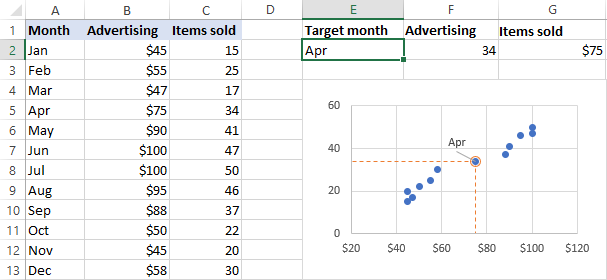
And here comes the last version of our scatter graph with the target information point highlighted, labeled and positioned on the axes:
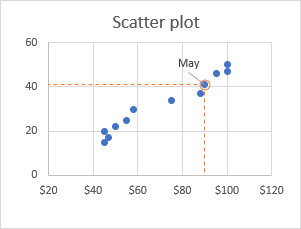
The best thing most it that you have to perform these customizations just 1. Due to the dynamic nature of Excel charts, the highlighted betoken will change automatically every bit soon as you lot input another value in the target cell (E2 in our case):
Show a position of boilerplate or benchmark point
The same technique can also be used to highlight the boilerplate, benchmark, smallest (minimum) or highest (maximum) point on a scatter diagram.
For example, to highlight the average point, you calculate the average of x and y values by using the Boilerplate function, and then add together these values as a new information serial, exactly as we did for the target calendar month. Equally the outcome, y'all will have a besprinkle plot with the boilerplate point labeled and highlighted:

That'due south how you lot can spot and highlight a sure data bespeak on a scatter diagram. To have a closer look at our examples, yous are welcome to download our sample Excel Scatter Plot workbook. I give thanks you for reading and hope to see you on our blog next week.
You may also be interested in
warrenthatintopen.blogspot.com
Source: https://www.ablebits.com/office-addins-blog/2018/10/10/find-data-point-excel-scatter-graph/
0 Response to "How Do I Find My Origin Point in Art Cam Express"
Post a Comment