what are three potential problems some people foresee happening if gm crops continue to be grown?
Genetically Modified Crops
- Level 1: Summary
- Level 2: Details
- Level three: Source
v. What furnishings could genetically modified crops accept on the environment?
- 5.1 What direct effects could genetically modified plants have on the surroundings?
- five.1.1 Factor flow
- 5.1.2 Not-target species
- 5.2 What indirect effects could genetically modified plants have on the environment?
- 5.2.1 Agronomical practices
- v.2.two Pesticide utilise
- v.2.3 Herbicide use
- 5.two.4 Pest and weed resistance
- 5.2.5 Difficult agricultural conditions
- five.3 How should these environmental furnishings be assessed?
five.1 What directly effects could genetically modified plants have on the environment?
-
- 5.1.one Factor flow
- v.ane.2 Non-target species
The source document for this Assimilate states:
ENVIRONMENTAL IMPLICATIONS
Agriculture of any blazon - subsistence, organic or intensive - affects the environment, then it is natural to await that the utilise of new genetic techniques in agronomics volition likewise affect the environment. The ICSU, the GM Science Review Panel and the Nuffield Quango on Bioethics, among others, agree that the ecology bear upon of genetically transformed crops may be either positive or negative depending on how and where they are used. Genetic engineering may advance the damaging furnishings of agriculture or contribute to more sustainable agronomical practices and the conservation of natural resource, including biodiversity. The ecology concerns associated with transgenic crops are summarized below along with the current state of scientific knowledge regarding them.
Releasing transgenic crops into the environment may have directly effects including: gene transfer to wild relatives or conventional crops, weediness, trait effects on non-target species and other unintended furnishings. These risks are similar for transgenic and conventionally bred crops (ICSU). Although scientists differ in their views on these risks, they agree that environmental impacts need to exist assessed on a case-by-case basis and recommend postal service-release ecological monitoring to notice whatsoever unexpected events (ICSU, Nuffield Quango, GM Science Review Console). Transgenic crops may also entail positive or negative indirect environmental effects through changes in agronomical practices such as pesticide and herbicide utilize and cropping patterns.
Transgenic copse involve similar environmental concerns, although there are additional concerns because of their long life cycle. Transgenic micro-organisms used in nutrient processing are normally used nether confined conditions and are generally not considered to pose environmental risks. Some micro-organisms can be used in the environs as biological control agents or for bioremediation of ecology damage (e.g. oil spills), and their ecology furnishings should exist assessed prior to release. Environmental concerns related to transgenic fish primarily focus on their potential to breed with and outcompete wild relatives (ICSU). Transgenic farm animals would probably be used in highly confined conditions, so they would pose little risk of environmental impairment (NRC, 2002) (Box 22).
Source & ©: FAO "The Land of Food and Agriculture 2003-2004"
Chapter 5: Health and environmental impacts of transgenic crops 
Section Environmental implications
- Level 1: Summary
- Level 2: Details
- Level iii: Source
5.one.ane Gene menstruum
The source document for this Digest states:
Scientists concur that cistron menstruation from GM crops is possible through pollen from open-pollinated varieties crossing with local crops or wild relatives. Considering gene flow has happened for millennia between country races and conventionally bred crops, information technology is reasonable to expect that it could besides happen with transgenic crops. Crops vary in their trend to outcross, and the power of a crop to outcross depends on the presence of sexually compatible wild relatives or crops, which varies according to location (Box 23 on page 70) (ICSU, GM Scientific discipline Review Console).
Scientists do not fully agree whether or not factor flow between transgenic crops and wild relatives matters, in and of itself (ICSU, GM Science Review Console). If a resulting transgenic/wild hybrid had some competitive advantage over the wild population it could persist in the environs and potentially disrupt the ecosystem. According to the GM Scientific discipline Review Panel, hybridization between transgenic crops and wild relatives seems "overwhelmingly probable to transfer genes that are advantageous in agricultural environments, but will non prosper in the wild … Furthermore, no hybrid between any crop and any wild relative has ever go invasive in the wild in the Great britain" (GM Scientific discipline Review Panel, 2003: xix).
Whether the otherwise benign flow of transgenes into state races or other conventional varieties would itself constitute an ecology problem is a affair of debate, because conventional crops have long interacted with state races in this way (ICSU). Research is needed to improve the assessment of the environmental consequences of gene flow, particularly in the long run, and to understand better the cistron flow between the major food crops and land races in centres of multifariousness (ICSU, GM Scientific discipline Review Console).
Weediness refers to the situation in which a cultivated plant or its hybrid becomes established as a weed in other fields or as an invasive species in other habitats. Scientists agree that at that place is simply a very depression risk of domesticated crops condign weeds themselves because the traits that make them desirable as crops frequently brand them less fit to survive and reproduce in the wild (ICSU, GM Science Review Panel). Weeds that hybridize with herbicide-resistant crops take the potential to acquire the herbicide-tolerant trait, although this would merely provide an advantage in the presence of the herbicide (ICSU, GM Scientific discipline Review Panel). According to the GM Scientific discipline Review Console, "Detailed field experiments on several GM crops in a range of environments have demonstrated that the transgenic traits investigated - herbicide tolerance and insect resistance - do non significantly increase the fitness of the plants in semi-natural habitats" (GM Science Review Panel, 2003:19). Some transgenic traits, such as pest or affliction resistance, could provide a fitness reward but in that location is little evidence so far that this happens or has whatsoever negative environmental consequences (ICSU, GM Science Review Console). More than testify is required regarding the outcome of fitness-enhancing traits on invasiveness (GM Science Review Panel).
Management and genetic methods are being adult to minimize the possibility of factor flow. The complete isolation of crops grown on a commercial calibration, either GM or non-GM, is not currently practical although gene catamenia can be minimized, equally it currently is between oilseed rape varieties grown for food, feed or industrial oils (GM Science Review Console). Direction strategies include avoiding the planting of transgenic crops in their centres of biodiversity or where wild relatives are present, or using buffer zones to isolate transgenic varieties from conventional or organic varieties. Genetic engineering tin can exist used to alter flowering periods to forestall cross-pollination or to ensure that the transgenes are non incorporated in pollen and developing sterile transgenic varieties (ICSU and Nuffield Council). The GM Science Review Console and other proficient bodies recommend that GM crops that produce medical or industrial substances should exist designed and grown in ways that would avoid factor period to nutrient and feed crops (GM Science Review Panel).
Source & ©: FAO "The Country of Food and Agronomics 2003-2004"
Chapter five: Health and environmental impacts of transgenic crops
Section Environmental implications, Subsection Gene flow
BOX 23
An ecologist's view of gene flow from transgenic cropsMost ecological scientists agree that factor flow is not an environmental trouble unless information technology leads to undesirable consequences. In the short term, the spread of transgenic herbicide resistance via gene menstruation may create logistical and/or economical problems for growers. Over the long term, transgenes that confer resistance to pests and environmental stress and/or pb to greater seed product have the greatest likelihood of aiding weeds or harming non-target species. Notwithstanding, these outcomes seem unlikely for about currently grown transgenic crops. Many transgenic traits are probable to exist innocuous from an ecology standpoint, and some could lead to more sustainable agronomical practices. To document various risks and benefits, at that place is a great demand for academic researchers and others to get more than involved in studying transgenic crops. Similarly, it is crucial that molecular biologists, crop breeders and industry better their understanding of ecological and evolutionary questions about the safety of new generations of transgenic crops. The presence of wild and weedy relatives varies among countries and regions. The nautical chart shows examples of major crops grouped by their ability to disperse pollen and the occurrence of weedy relatives in the continental United States. This elementary ii x 2 matrix tin be useful in identifying cases where factor flow from a transgenic crop to a wild relative is likely. For crops where no wild or weedy relatives are grown nearby - as with soybean, cotton and maize shown hither in green - factor menses to the wild would not occur. Rice, sorghum and wheat have wild relatives in the United States and a relatively low trend to outcross, which could let transgenes to disperse into wild populations. The crops that take a high trend to outcross and have wild relatives in the United states of america are shown in crimson. There is a high potential for gene period betwixt these crops and their wild relatives, so care should be taken in growing transgenic varieties that might confer a competitive advantage on their hybrids.
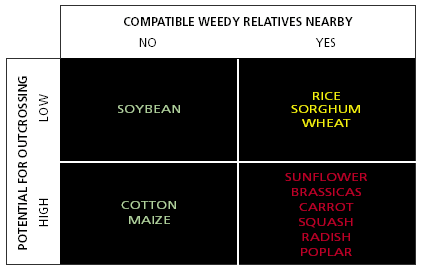
Source & ©: FAO "The State of Nutrient and Agronomics 2003-2004"
Chapter 5: Health and ecology impacts of transgenic crops
- Level 1: Summary
- Level 2: Details
- Level iii: Source
5.1.2 Non-target species
The source certificate for this Assimilate states:
Trait effects on non-target species
Some transgenic traits - such as the pesticidal toxins expressed by Bt genes - may touch non-target species every bit well as the crop pests they are intended to control (ICSU). Scientists concur that this could happen but they disagree about how probable it is (ICSU, GM Science Review Panel). The monarch butterfly controversy (Box 24 on folio 71) demonstrated that it is difficult to extrapolate from laboratory studies to field conditions. Field studies have shown some differences in soil microbial customs structure between Bt and not-Bt crops, merely these are inside the normal range of variation found between cultivars of the aforementioned ingather and do non provide disarming testify that Bt crops could exist damaging to soil health in the long term (GM Scientific discipline Review Console). Although no pregnant agin effects on not-target wildlife or soil health have and so far been observed in the field, scientists disagree regarding how much evidence is needed to demonstrate that growing Bt crops is sustainable in the long term (GM Scientific discipline Review Panel). Scientists agree that the possible impacts on non-target species should exist monitored and compared with the furnishings of other current agricultural practices such as chemical pesticide use (GM Scientific discipline Review Console). They acknowledge that they demand to develop meliorate methods for field ecological studies, including better baseline data with which to compare new crops (ICSU).
Source & ©: FAO "The State of Food and Agriculture 2003-2004"
Chapter v: Health and environmental impacts of transgenic crops
Section Environmental implications
Subsection Trait furnishings on not-target species
BOX 24
Does Bt maize kill monarch collywobbles?John Losey, an entomologist at Cornell University, published a research paper in the scientific journal Nature that seemed to show that pollen from Bt maize killed monarch butterflies (Losey, Rayor and Carter, 1999). Losey and his colleagues institute that when they spread the pollen from a commercial diverseness of Bt maize on milkweed leaves in the laboratory and fed them to monarch butterfly caterpillars, the caterpillars died. Six independent teams of researchers conducted follow-upward studies on the effects of Bt maize pollen on monarch butterfly caterpillars, published in 2001 in the Proceedings of the National Academy of Sciences of the U.s.. Although these studies agreed that the pollen used in the original written report was toxic at high doses, they found that Bt maize pollen posed negligible chance to monarch larvae nether field conditions. They based their determination on 4 facts: (a) the Bt toxin is expressed at fairly depression levels in the pollen of most commercial Bt maize varieties, (b) maize and milkweed (the normal food of monarch butterfly caterpillars) are generally non found together in the field, (c) at that place is express overlap in the time periods when maize pollen sheds in the field and monarch larvae are active and (d) the corporeality of pollen probable to be consumed under field conditions was not toxic. These studies ended that the take chances of impairment to monarch butterfly caterpillars from Bt maize pollen is very small-scale, particularly in comparison with other threats such as conventional pesticides and drought (Conner, Glare and Nap, 2003).
Many scientists are frustrated by the way the monarch butterfly controversy and other issues related to biotechnology were handled in the press. Although the original monarch butterfly study received worldwide media attention, the follow-upward studies that refuted it did not receive the same corporeality of coverage. As a event, many people are not aware that Bt maize poses very little run a risk to monarch butterflies (Pew Initiative, 2002a).
Source & ©: FAO "The State of Food and Agriculture 2003-2004"
Affiliate 5: Health and environmental impacts of transgenic crops
- Level 1: Summary
- Level 2: Details
- Level 3: Source
5.2 What indirect effects could genetically modified plants accept on the surround?
-
- 5.2.1 Agricultural practices
- five.2.2 Pesticide use
- v.2.three Herbicide employ
- 5.ii.4 Pest and weed resistance
- 5.ii.5 Difficult agricultural conditions
5.ii.i Agricultural practices
The source document for this Digest states:
Indirect environmental furnishings
Transgenic crops may have indirect environmental effects equally a result of changing agricultural or environmental practices associated with the new varieties. These indirect furnishings may be beneficial or harmful depending on the nature of the changes involved (ICSU, GM Scientific discipline Review Panel). Scientists concur that the use of conventional agricultural pesticides and herbicides has damaged habitats for farmland birds, wild plants and insects and has seriously reduced their numbers (ICSU, GM Science Review Panel, Purple Lodge). Transgenic crops are irresolute chemical and state-utilise patterns and farming practices, simply scientists do not fully concur whether the net effect of these changes will be positive or negative for the environment (ICSU). Scientists acknowledge that more than comparative analysis of new technologies and current farming practices is needed.
Source & ©: FAO "The State of Food and Agronomics 2003-2004"
Chapter five: Wellness and ecology impacts of transgenic crops
Department Environmental implications, Subsection Indirect environmental furnishings
- Level 1: Summary
- Level 2: Details
- Level 3: Source
v.2.2 Pesticide utilize
The source document for this Assimilate states:
Pesticide use
The scientific consensus is that the employ of transgenic insect-resistant Bt crops is reducing the volume and frequency of insecticide use on maize, cotton and soybean (ICSU). These results have been especially significant for cotton fiber in Australia, Cathay, Mexico, Southward Africa and the United States (Chapter 4). The environmental benefits include less contagion of h2o supplies and less damage to non-target insects (ICSU). Reduced pesticide use suggests that Bt crops would exist mostly beneficial to in-ingather biodiversity in comparison with conventional crops that receive regular, broad-spectrum pesticide applications, although these benefits would exist reduced if supplemental insecticide applications were required (GM Science Review Console). As a consequence of less chemical pesticide spraying on cotton fiber, demonstrable health benefits for farm workers take been documented in China (Pray et al., 2002) and South Africa (Bennett, Morse and Ismael, 2003).
Source & ©: FAO "The State of Food and Agriculture 2003-2004"
Chapter 5: Wellness and environmental impacts of transgenic crops
Section Environmental implications, Subsection Pesticide utilize
- Level 1: Summary
- Level 2: Details
- Level 3: Source
5.ii.3 Herbicide apply
The source document for this Assimilate states:
Herbicide use
Herbicide use is changing as a event of the rapid adoption of HT crops (ICSU). At that place has been a marked shift abroad from more toxic herbicides to less toxic forms, but full herbicide use has increased (Traxler, 2004). Scientists agree that HT crops are encouraging the adoption of depression-till crops with resulting benefits for soil conservation (ICSU). There may be potential benefits for biodiversity if changes in herbicide use allow weeds to emerge and remain longer in farmers' fields, thereby providing habitats for farmland birds and other species, although these benefits are speculative and have not been strongly supported by field trials to engagement (GM Scientific discipline Review Panel). There is concern, however, that greater use of herbicides - even less toxic herbicides - will further erode habitats for farmland birds and other species (ICSU). The Royal Guild has published the results of extensive farm-scale evaluations of the impacts of transgenic HT maize, bound oilseed rape (canola) and carbohydrate beet on biodiversity in the United kingdom. These studies institute that the master effect of these crops compared with conventional cropping practices was on weed vegetation, with consequent effects on the herbivores, pollinators and other populations that feed on it. These groups were negatively affected in the case of transgenic HT sugar beet, positively affected in the case of maize and showed no consequence in leap oilseed rape. They conclude that commercialization of these crops would take a range of impacts on farmland biodiversity, depending on the relative efficacy of transgenic and conventional herbicide regimes and the caste of buffering provided by surrounding fields (Regal Social club, 2003:1912). Scientists acknowledge that there is insufficient evidence to predict what the long-term impacts of transgenic HT crops volition be on weed populations and associated in-crop biodiversity (GM Scientific discipline Review Console).
Source & ©: FAO "The Country of Food and Agriculture 2003-2004"
Chapter 5: Health and ecology impacts of transgenic crops
Section Environmental implications, Subsection Herbicide employ
- Level i: Summary
- Level 2: Details
- Level iii: Source
5.ii.iv Pest and weed resistance
The source document for this Digest states:
Pest and weed resistance
Scientists concur that extensive long-term use of Bt crops and glyphosate and gluphosinate, the herbicides associated with HT crops, can promote the evolution of resistant insect pests and weeds (ICSU, GM Science Review Panel). Similar breakdowns accept routinely occurred with conventional crops and pesticides and, although the protection conferred past Bt genes appears to be particularly robust, there is no reason to assume that resistant pests will not develop (GM Science Review Console). Worldwide, over 120 species of weeds have developed resistance to the dominant herbicides used with HT crops, although the resistance is not necessarily associated with transgenic varieties (ICSU, GM Science Review Panel). Considering the evolution of resistant pests and weeds tin can exist expected if Bt and glyphosate and gluphosinate are overused, scientists advise that a resistance direction strategy exist used when transgenic crops are planted (ICSU). Scientists disagree nearly how effectively resistance direction strategies can be employed, particularly in developing countries (ICSU). The extent and possible severity of impacts of resistant pests or weeds on the environment are subject to debate (GM Scientific discipline Review Panel).
Source & ©: FAO "The State of Nutrient and Agriculture 2003-2004"
Chapter five: Health and ecology impacts of transgenic crops
Section Environmental implications, Subsection Pest and weed resistance
- Level 1: Summary
- Level 2: Details
- Level 3: Source
5.2.5 Difficult agricultural conditions
The source document for this Digest states:
Abiotic stress tolerance
As we saw in Chapter 2, new transgenic crops with tolerance to various abiotic stresses (e.g. salt, drought, aluminium) are existence developed that may allow farmers to cultivate soils that were previously not arable. Scientists agree that these crops may be environmentally benign or harmful depending on the particular crop, trait and environs (ICSU).
Source & ©: FAO "The State of Food and Agriculture 2003-2004"
Chapter v: Wellness and ecology impacts of transgenic crops
Section Environmental implications, Subsection Abiotic stress resistance
- Level i: Summary
- Level 2: Details
- Level three: Source
5.3 How should these ecology effects be assessed?
The source certificate for this Digest states:
Environmental touch on assessment
There is wide consensus that the environmental impacts of transgenic crops and other living modified organisms (e.g. transgenic seeds) should be evaluated using science-based chance assessment procedures on a case-past-case basis depending on the particular species, trait and agro-ecosystem. Scientists also hold that the environmental release of transgenic organisms should be compared with other agricultural practices and technology options (ICSU and Nuffield Quango).
As we saw to a higher place, nutrient safety cess procedures are well developed and the FAO/WHO Codex Alimentarius Committee provides an international forum for developing food safety guidelines for transgenic foods. By contrast, there are no internationally agreed guidelines and standards for assessing the environmental impacts of transgenic organisms (ICSU). Scientists concur that in that location is a need for internationally and regionally harmonized methodologies and standards for assessing environmental impacts in different ecosystems (ICSU; FAO, 2004). The part of international standard-setting bodies in providing guidance for risk analysis is described beneath.
According to the ICSU, regulators in dissimilar countries typically require similar types of data for ecology bear on assessments, but they differ in their estimation of these information and of what constitutes an environmental risk or harm. Scientists too differ on what the appropriate footing for comparison should exist: with current agricultural systems and/or baseline ecological data (ICSU). An FAO good consultation (2004) agreed that the impacts of agriculture on the surround were much greater than the measurable impacts of a shift from conventional to transgenic crops, and so the footing of comparing is important.
Scientists also disagree about the value of small-scale laboratory and field trials and their extrapolation to big-scale effects, and it is unclear whether modelling approaches that comprise data from geographical information systems would be useful in predicting the effects of living modified organisms (LMOs) in dissimilar ecosystems (ICSU). The scientific customs recommends that more research is needed on the postal service-release furnishings of transgenic crops. There is as well a need for more targeted post-release monitoring and ameliorate methodologies for monitoring (ICSU; FAO, 2004).
Source & ©: FAO "The State of Food and Agriculture 2003-2004"
Chapter 5: Health and environmental impacts of transgenic crops
Department Environmental impact assessment
warrenthatintopen.blogspot.com
Source: https://www.greenfacts.org/en/gmo/3-genetically-engineered-food/5-gene-flow.htm
0 Response to "what are three potential problems some people foresee happening if gm crops continue to be grown?"
Post a Comment